
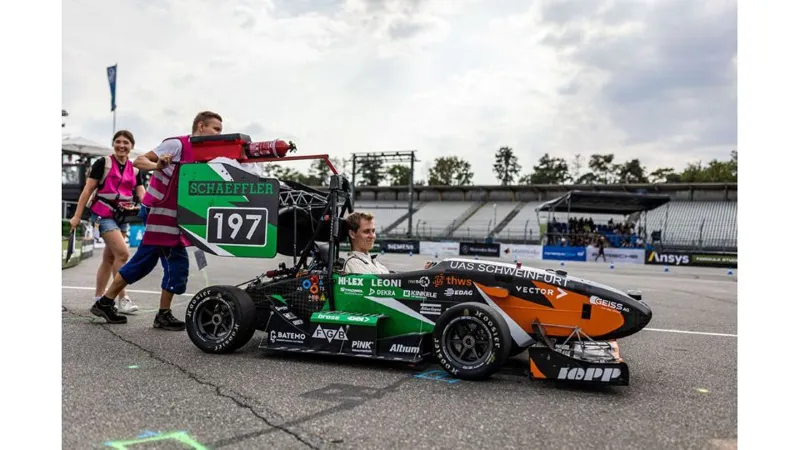
When it comes to motorsport, every gram matters. For the Formula Student team Mainfranken Racing e.V. at the Technical University of Würzburg-Schweinfurt in Germany, producing lightweight, high-performance carbon fibre components is central to building a competitive race car — and advanced vacuum technology from Atlas Copco is making it possible.
Each year, the student engineering team designs and assembles an entirely new race car from scratch as part of a prestigious international design competition. Carbon fibre plays a critical role in their builds, offering an exceptional strength-to-weight ratio that directly translates to track performance. To manufacture these components with the precision and consistency required, the team relies on the Atlas Copco GVS 100A — an oil-sealed rotary vane vacuum pump sponsored by Atlas Copco Vacuum.
From Fiber to Finished Part
The process begins with carefully cutting and layering multiple sheets of carbon fibre fabric, each impregnated with epoxy resin. The orientation of each layer is deliberately varied to distribute stress in the right directions. Once layered, the component is either placed inside a vacuum chamber or sealed airtight with a special vacuum film.
This is where the GVS 100A goes to work. The pump generates a consistent, stable vacuum that draws out trapped air pockets from within the laminate — a step that is crucial for eliminating weak spots and ensuring structural integrity. After approximately twelve hours of curing at high temperature, the result is a finished carbon component strong enough to endure the extreme demands of competitive racing.
A Pump Built for Demanding Work
The GVS 100A was specifically engineered for demanding industrial applications. Its oil-sealed design delivers a stable, consistent vacuum essential for precision manufacturing processes. An integrated oil separation system keeps the working environment clean by minimizing oil vapors in the exhaust air, while a gas ballast valve assists with moisture-laden gases. A check valve at the inlet prevents backflow and enhances overall system safety.
Despite its robust capabilities, the pump remains compact and straightforward to operate. Low noise levels, minimal maintenance requirements, and suitability for continuous operation make it a practical fit for a student team working under tight time and resource constraints.
Investing in the Next Generation
This collaboration between Atlas Copco and Mainfranken Racing goes beyond equipment sponsorship — it reflects a broader commitment to nurturing future engineers. By giving students access to professional-grade vacuum technology, Atlas Copco is helping bridge the gap between academic learning and real-world industrial practice.
“The combination of innovative vacuum technology and student engineering skills impressively demonstrates how important reliable tools are in the manufacture of high-performance components,” the company noted. For the Mainfranken Racing team, having access to the right technology isn’t just about winning races — it’s about developing the skills and confidence to shape the future of engineering.