
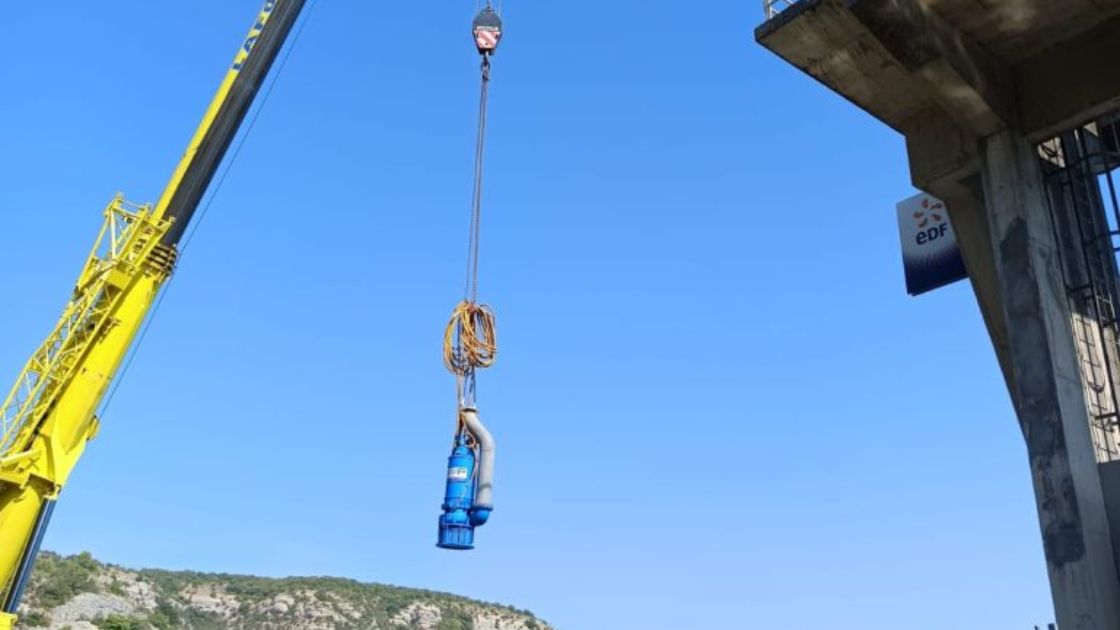
During the construction of a new 250-metre-long bypass road to secure a tunnel in the Gorges du Verdon, 180.000 cubic metres of water had to be drained in a controlled manner – under geologically challenging conditions in one of the steepest and deepest limestone gorges in Europe.
Pump manufacturer Tsurumi used a multi-stage high-performance system to reliably ensure water drainage in this extreme terrain.
The Gorges du Verdon are one of Europe’s most spectacular natural phenomena: over thousands of years, the Verdon River has carved a spectacular gorge into the limestone massif. The gorge stretches for around 21 kilometres between its start near Castellane and the Lac de Sainte-Croix reservoir. In some places, the rock faces rise up to 700 metres. This topography makes construction and development work in this region technically challenging when new transport routes such as bypasses or tunnels are planned.
The current construction project, a 250-metre-long bypass road to secure an existing tunnel, initially presented a huge hydrological challenge: 180.000 cubic metres of water had to be drained in a controlled manner before rock work could begin. To achieve this, the pump manufacturer Tsurumi installed a high-performance system consisting of pumps from several series via its French subsidiary – a technically sophisticated solution for extreme operating conditions.
Tsurumi’s expertise
The situation on site was challenging: The pumps were lowered to a depth of 22 metres and the accumulated water had to be drained via a horizontal pipe with a height difference of around 21 metres. In addition, pipes, electrical connections and settling basins had to be prepared – all under the complex geological and topographical conditions of the Verdon Gorge. Only with careful planning and robust technology was it possible to achieve such water drainage.
On Tuesday, 3 September at 8:30, the pump system was started up. A combination of one GSZ pump, two KRD pumps and three LH pumps took over the drainage. The GSZ pump, known for its very high flow rates and robust construction, handled the main volume flow: typical features of this series are flow rates of over 10.000 litres per minute, motor outputs of up to 30 kW, wear-resistant hydraulics and a heavy-duty casing – ideal for large-volume and continuous dewatering, even with abrasive dirty water. The two KRD pumps provided additional support: thanks to integrated agitators, sediments and deposits could be stirred up and kept transportable – a great help given the sometimes considerable sludge load in the gorge. The three LH pumps rounded off the system: their multi-stage design allows high pressures and extreme delivery heads (up to 216 metres for the LH-W series), making them ideal for discharging water over height differences and longer transport distances. The robust solid cast construction of the LH pumps also ensures maximum stability and reliability in difficult environments.
Special pump network
Within just under 43 hours (until Thursday, 5 September at 1:30), the pumps had already pumped out 90.000 cubic metres of water. The remaining water was then able to drain away by gravity – a result that impressively demonstrated the performance and efficiency of the pump system used. The pumps operated without interruption throughout the entire pumping process, even though the conditions were anything but easy.
Why this particular pump concept? In the Verdon Gorge area, heavy sedimentation, high water volumes and potentially unstable ground conditions pose a considerable technical challenge. Conventional pumps would possibly be overloaded or damaged by abrasive material. The combination of powerful, wear-resistant GSZ pumps, agitator-assisted KRD pumps for sediment mobilisation and high-pressure LH pumps for overcoming significant differences in height ensured robust, continuous and controlled drainage: an essential prerequisite for carrying out the subsequent tunnel and road construction work safely and efficiently.
In addition, a construction project of this kind in the region poses not only hydraulic but also geological and topographical challenges. The limestone rock faces, steep terrain and large differences in elevation require not only precise planning but also flexible, powerful technology. The use of Tsurumi pumps demonstrates how modern pump technology can be crucial in ensuring water logistics under such conditions.
90.000 cubic metres in 43 hours
The construction project ultimately serves to provide sustainable transport access and safety in this sensitive and spectacular landscape. With the successful drainage of the water, the foundation was laid for the rock work to begin.
The use of dirty water pumps has shown that even under extreme conditions, large volumes of water can be managed in a controlled manner – proof of technical excellence and practical engineering ‘Made in Japan’. For construction companies, engineering firms or civil engineering projects operating in challenging terrain such as gorges, mountains or narrow valleys, this example provides a clear indication: with the right pump technology and support from the manufacturer, even large-scale dewatering projects in complex infrastructure projects can be managed on schedule. The fact that Tsurumi keeps its entire product range for Europe in local warehouses and can deliver within hours may prove to be the trump card in acute situations.