
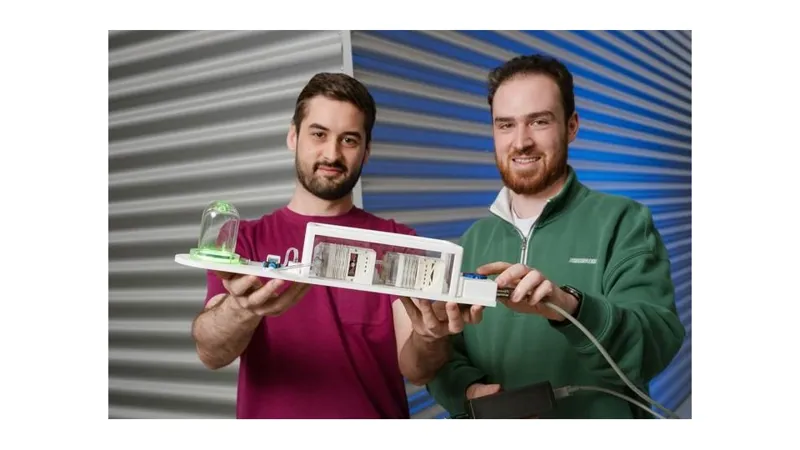
What if you could generate vacuum pressure without a motor, compressed air, or lubricants? Researchers at **Saarland University **(Germany) are making that vision a reality—with an ultrathin polymer film that could redefine how we think about fluid power and actuation.
Showcased at Hannover Messe 2026 (Hall 11, Stand D41), this breakthrough prototype isn’t just a lab curiosity. It’s a glimpse into a future where vacuum systems are quieter, leaner, smarter, and infinitely more adaptable.
🔬 The Core Innovation: Dielectric Elastomer Actuators
At the heart of the technology is a silicone membrane just 50 micrometres thick—roughly the width of a human hair. This isn’t ordinary plastic; it’s a dielectric elastomer, a class of “smart materials” that deform predictably when exposed to electrical voltage.
| Traditional Vacuum Pump | Polymer Film Pump |
|---|---|
| Motor-driven mechanical components | Electrically responsive polymer membrane |
| Requires lubricants, compressed air | Lubricant-free, air-free operation |
| Bulky, rigid geometries | Ultra-thin, flexible, customizable shapes |
| Audible noise and vibration | Near-silent operation |
| Limited design flexibility | Tailored geometries (e.g., smartphone-thin profiles) |
When voltage is applied, the film moves in precisely controlled patterns—acting as a miniature actuator that generates the pushing and pulling forces needed to create vacuum pressure. No gears. No pistons. No motors.
🎯 Why This Matters: Design Freedom Meets Functional Efficiency
Led by Professor Paul Motzki, the Saarland University team has engineered more than just a novel material—they’ve unlocked new possibilities for system integration:
✅ Custom geometries: Create pumps in shapes impossible with conventional mechanics—think ultra-flat designs for portable medical devices or embedded industrial sensors.
✅ Dual-drive architecture: The latest prototype connects two actuators in parallel or series, boosting pressure, flow rate, and power on demand.
✅ Cleanroom-ready: No lubricants = no contamination risk. Ideal for semiconductor manufacturing, pharmaceuticals, and precision optics.
✅ Energy-efficient operation: Depending on the mode, the system can significantly reduce power consumption versus motor-driven equivalents.
✅ Sustainable by design: No rare earth materials, minimal waste, and longer service life due to fewer moving parts.
“Using dielectric elastomers, we can tailor pump geometries to specific requirements. That means we can create forms that would not be technically feasible using conventional approaches. For example, we can produce extremely thin, flat designs comparable to the shape of a smartphone.”
— Professor Paul Motzki, Saarland University
🌐 Applications Across Industries
This technology isn’t niche—it’s broadly enabling:
| Sector | Potential Use Case |
|---|---|
| Medical Technology | Portable diagnostic devices, wearable drug delivery systems, lab-on-a-chip platforms |
| Semiconductor Manufacturing | Compact vacuum modules for wafer handling in cleanrooms |
| Industrial Automation | Lightweight, low-noise actuators for collaborative robots and precision assembly |
| Aerospace & Defense | Vibration-free fluid control in sensitive instrumentation |
| Research & Analytics | Miniaturized vacuum sources for portable spectrometers or sampling systems |
🔁 What’s Next? From Lab to Industry
The prototype is proven. Now, the team is seeking industrial partners to co-develop applications, optimize for scale, and bring this technology to market.
For forward-thinking OEMs and system integrators, this represents a rare opportunity: ✨ Be first-to-market with motor-free fluid handling solutions
✨ Differentiate with ultra-compact, silent, clean-compatible designs
✨ Reduce total cost of ownership through simplified maintenance and lower energy use