
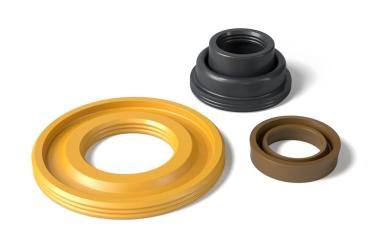
In mechanical design, tolerances aren’t just numbers on a drawing—they’re the difference between smooth operation and costly rework, between reliable performance and premature failure. When housing bores, shaft diameters, or assembly variations fall outside ideal ranges, traditional sealing approaches often demand expensive machining, selective fitting, or complex compensation strategies.
That’s why Parker Prädifa, the sealing technology specialist within Parker Hannifin, has spotlighted its WARP seal technology: an engineered solution that actively manages tolerance variation through intelligent material design—delivering reliable sealing performance even when component dimensions fluctuate.
Announced on May 6, 2026, this isn’t just another seal product. It’s a strategic enabler for manufacturers seeking to reduce machining costs, accelerate assembly, and improve field reliability—without compromising sealing integrity.
🎯 Why Tolerance Management Matters in Sealing Applications
Mechanical assemblies rarely operate in a world of perfect dimensions:
| Tolerance Challenge | Impact on Traditional Seals | WARP Seal Solution |
|---|---|---|
| Housing bore variation | Requires tight machining tolerances or selective assembly | Elastic seal geometry accommodates ±0.2–0.5 mm bore variation without leakage |
| Shaft runout or eccentricity | Causes uneven lip loading, accelerated wear, and leakage | Adaptive sealing lip maintains contact pressure across dynamic misalignment |
| Thermal expansion differences | Metal/plastic component mismatch creates gaps or excessive compression | Material formulation compensates for temperature-induced dimensional changes |
| Assembly misalignment | Manual installation errors compromise seal positioning | Forgiving design tolerates minor angular or axial misplacement during press-fit |
| Wear over lifecycle | Fixed-geometry seals lose effectiveness as components wear | Self-compensating geometry maintains sealing force as mating surfaces degrade |
For design and manufacturing teams, the question isn’t whether to manage tolerances—it’s how to do it cost-effectively without sacrificing performance.
🔧 What Is WARP Seal Technology?
WARP (Wide Acceptance Range Profile) seals leverage engineered elastomer geometry and material science to create a sealing solution that adapts to variation rather than resisting it:
✅ Elastic interference design – Seal cross-section compresses and expands to accommodate dimensional variation while maintaining optimal contact pressure
✅ Adaptive lip geometry – Sealing edge conforms to shaft irregularities, runout, or minor surface defects without losing integrity
✅ Broad material portfolio – FKM, FFKM, NBR, EPDM, and specialty compounds selected for chemical, temperature, and wear resistance
✅ Simplified installation – Forgiving press-fit design reduces assembly errors and eliminates need for precision alignment tools
✅ Standardized dimensions – Compatible with common housing specifications, reducing custom tooling requirements
“Tolerances are inevitable. WARP technology turns that reality into an advantage—letting designers specify practical machining ranges while ensuring sealing performance never compromises.”
— Parker Prädifa Sealing Technology Team
📊 Technical Capabilities: Engineered for Real-World Variation
| Parameter | Typical Capability | Design Benefit |
|---|---|---|
| Bore tolerance accommodation | ±0.2 to ±0.5 mm (depending on size) | Reduces machining cost; enables use of cast or molded housings |
| Shaft runout tolerance | Up to 0.3 mm TIR | Maintains seal integrity despite bearing wear or assembly variation |
| Temperature range | -40°C to +200°C (material-dependent) | Consistent performance across thermal cycling and operating extremes |
| Pressure rating | Static: up to 10 bar; Dynamic: up to 0.5 bar | Suitable for lubrication systems, hydraulic circuits, and low-pressure fluid containment |
| Surface finish tolerance | Accommodates Ra 0.2–1.6 µm | Reduces finishing cost on shafts and housings without compromising seal life |
🏭 Applications Where WARP Seals Deliver Immediate Value
| Sector | Use Case | WARP Seal Advantage |
|---|---|---|
| Automotive & Mobility | Transmission seals, e-axle housings, battery cooling circuits | Accommodates cast aluminum housing variation; reduces machining cost per unit |
| Industrial Machinery | Gearbox seals, pump housings, actuator cylinders | Tolerates assembly misalignment; simplifies field service and replacement |
| Off-Highway & Agriculture | Hydraulic systems, final drives, PTO shafts | Withstands vibration, contamination, and dimensional wear over long service life |
| Fluid Power | Valve bodies, manifold blocks, cylinder rods | Compensates for thermal expansion in high-cycle hydraulic applications |
| Consumer Appliances | Motor seals, pump housings, detergent compartments | Enables cost-effective plastic molding while maintaining reliable sealing |
💡 Why WARP Technology Delivers Real ROI
| Challenge | How WARP Seals Help | Quantifiable Benefit |
|---|---|---|
| High machining costs | Wider acceptable bore/shaft tolerances reduce precision grinding requirements | 15–30% reduction in component machining cost |
| Assembly complexity | Forgiving installation reduces need for precision alignment tools or selective fitting | 20–40% faster assembly cycle time |
| Field failure risk | Adaptive geometry maintains sealing force despite wear, vibration, or thermal cycling | 25–50% reduction in warranty claims related to leakage |
| Design iteration time | Standardized seal profiles accommodate multiple housing variants without custom tooling | Faster time-to-market for platform-based product families |
| Supply chain flexibility | Single seal part number replaces multiple tolerance-specific SKUs | Simplified procurement and inventory management |
*Based on Parker Prädifa customer deployments; actual results vary by application and implementation.
🔌 Integration Made Simple: Designing with WARP Seals
Parker Prädifa supports WARP seal adoption with practical engineering resources:
✨ CAD library integration – Downloadable 3D models and 2D drawings for seamless design incorporation
✨ Tolerance calculation tools – Online calculators help engineers determine acceptable variation ranges for specific applications
✨ Material selection guidance – Application engineers assist with compound selection for chemical, temperature, and wear requirements
✨ Prototype support – Rapid sampling enables validation before production tooling commitment
✨ Installation documentation – Clear press-fit specifications and assembly videos reduce field errors
No guesswork. No over-engineering. Just reliable sealing that works with your manufacturing reality.
🌱 Sustainability Through Smart Design
Tolerance-tolerant sealing isn’t just about cost—it’s about resource intelligence:
♻️ Reduced machining waste – Wider tolerance acceptance minimizes material removal and energy consumption in component production
♻️ Extended service life – Adaptive geometry compensates for wear, delaying replacement and reducing spare parts demand
♻️ Lightweighting enablement – Forgiving seals allow use of cast or molded housings vs. precision-machined metal, reducing component weight
♻️ Scrap reduction – Fewer rejected assemblies due to tolerance-related sealing failures improves overall manufacturing yield
In an era where ESG performance influences procurement and financing, intelligent sealing design delivers measurable sustainability value.
🔁 Retrofit & Modernization: Upgrade Existing Designs
WARP technology isn’t just for new products. Many existing applications can benefit from retrofit:
✅ Direct replacement – Many WARP profiles fit standard housing dimensions, enabling drop-in upgrades
✅ Performance improvement – Replace traditional lip seals with WARP technology to reduce leakage in aging equipment
✅ Cost reduction – Relax machining tolerances on replacement components when paired with WARP seals
✅ Field service simplification – Forgiving installation reduces technician training requirements and assembly errors
“You don’t need to redesign your entire system to benefit from tolerance management. Often, a simple seal upgrade unlocks significant cost and reliability gains.”
— Parker Prädifa Application Engineering