
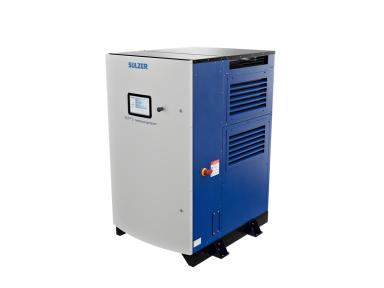
For decades, advanced aeration technology came with a caveat: scale required budget. High-efficiency turbo compressors delivered remarkable energy savings and process control—but their footprint, complexity, and upfront cost often placed them out of reach for smaller wastewater treatment facilities.
That barrier just got smaller.
A new generation of compact turbo compressors is now purpose-built for treatment works serving populations under 50,000—delivering the efficiency, intelligence, and reliability of large-scale aeration technology in a package designed for constrained sites, limited budgets, and lean operational teams.
Announced on May 5, 2026, this isn’t just a downsized product. It’s a strategic enabler for equitable access to next-generation wastewater treatment.
🎯 Why Smaller Plants Need Smart Aeration Too
| Challenge for Small Facilities | Impact |
|---|---|
| High energy costs | Aeration can consume 50–70% of a plant’s total electricity bill |
| Limited technical staff | Complex systems require specialized expertise that may not be onsite |
| Space constraints | Urban or retrofitted sites lack room for large blower rooms |
| Variable flows | Small communities experience sharp diurnal and seasonal load swings |
| Regulatory pressure | Discharge limits apply equally regardless of plant size |
Traditional solutions forced a compromise: reliability vs. efficiency, simplicity vs. intelligence, affordability vs. performance.
The new compact turbo compressor eliminates that trade-off.
🔧 What Makes This Turbo Compressor Different?
Engineered specifically for small-to-midsize treatment works, this platform combines proven turbo technology with practical design innovations:
| Feature | Benefit for Small Facilities |
|---|---|
| Footprint reduced by ~40% vs. conventional turbos | Fits in existing blower rooms or modular enclosures; ideal for retrofits |
| Plug-and-play controls with intuitive HMI | Minimal training required; remote monitoring via web or mobile app |
| Integrated VFD + smart surge protection | Handles variable flows without manual intervention or risk of damage |
| Magnetic or air foil bearings (oil-free option) | Eliminates lubrication maintenance; reduces environmental risk |
| Modular, skid-mounted design | Rapid installation, simplified logistics, scalable capacity |
This isn’t “turbo-lite.” It’s turbo-smart: engineered for the realities of small-plant operations.
💡 Real-World Value: Where the Savings Add Up
| Cost Category | Traditional Blowers | Compact Turbo Compressor | Annual Savings Potential* |
|---|---|---|---|
| Energy | Fixed-speed, throttled operation | Dynamic speed control matched to demand | 25–40% reduction |
| Maintenance | Regular oil changes, filter replacements, bearing inspections | Oil-free design, predictive diagnostics, remote support | 30–50% reduction |
| Downtime | Reactive repairs, parts lead times | Self-protecting controls, local service network | 20–35% fewer unplanned stops |
| Footprint | Large foundation, extensive piping | Compact skid, minimal civil works | Lower installation CAPEX |
*Based on typical 1 MGD facility with 24/7 aeration demand; actual results vary by site conditions.
For a small municipality operating on tight margins, these aren’t abstract percentages—they’re funds redirected to other critical infrastructure needs.
🌐 Smart Connectivity: Intelligence Without Complexity
The compact turbo compressor embraces digitalization—without overwhelming small-plant teams:
✅ Remote monitoring dashboard – Track performance, energy use, and alerts from any device
✅ Predictive maintenance alerts – Receive notifications before minor issues become failures
✅ Automated reporting – Generate compliance-ready logs for regulators or grant applications
✅ **Open protocols **(OPC UA, Modbus) – Integrate with existing SCADA or cloud platforms
No data science degree required. Just actionable insights, delivered simply.
🏭 Applications Where Compact Turbos Shine
| Facility Type | Use Case | Why This Solution Fits |
|---|---|---|
| Small Municipal WWTPs (<5 MGD) | Secondary treatment aeration, nitrification support | Right-sized capacity, easy operation, energy savings |
| Industrial Pretreatment | Food processing, breweries, dairy facilities | Handles variable organic loads; oil-free option for sensitive processes |
| Decentralized / Package Plants | Resorts, campuses, remote communities | Modular design supports phased expansion; remote diagnostics reduce travel |
| Retrofit Projects | Upgrading aging roots blowers or multi-stage centrifugals | Minimal civil modification; drop-in replacement potential |
🌱 Sustainability Through Efficiency
Smaller plants often lack the resources to prioritize sustainability—but this compressor makes it effortless:
♻️ Lower carbon footprint – Energy savings directly reduce Scope 2 emissions
♻️ Oil-free operation option – Eliminates risk of lubricant contamination in effluent
♻️ Longer service intervals – Fewer replacements, less waste, lower embodied carbon
♻️ Noise reduction – Quieter operation supports community relations in urban settings
In an era where ESG performance influences grant eligibility and public trust, these features deliver tangible value.
🔁 Retrofit-Ready: Upgrade Without Overhaul
Many small facilities operate blowers installed decades ago. This compact turbo is designed for brownfield adoption:
✅ Dimensional compatibility – Fits existing foundations and piping layouts
✅ Electrical integration – Standard voltage options; soft-start reduces grid impact
✅ Phased implementation – Replace one unit at a time to manage capital outlay
✅ Performance guarantees – Documented efficiency gains support ROI justification
No “rip and replace” required. Just smarter aeration, delivered practically.
💬 Leadership Perspective
“Small treatment works deserve the same access to efficient, reliable technology as large utilities. This compact turbo compressor isn’t about compromise—it’s about thoughtful engineering that respects the constraints of smaller operations while delivering the performance our industry demands.”
— Product Engineering Leadership